Best Credit Cards for Rental Car Insurance and Protection
Published: 18 Oct 2026
Renting a car for a family trip is rarely cheap. The rental counter often adds a damage waiver that can cost around $15 to $30 per day, which is a big extra on a week-long vacation. The right card can cover that risk for free.
This guide covers the best credit cards for rental car insurance, how primary and secondary coverage differ, and what these cards do not cover. You will also get a counter script, a claim checklist, and a simple way to pick a card for each type of trip.
Best credit cards for rental car insurance: quick picks
Here is the short version. Coverage terms below come from recent card guides and card reviews. Always confirm them in your card’s official Guide to Benefits before you travel.
| Card | Coverage type | Reported limit | Best for |
| Chase Sapphire Preferred | Primary | Up to $60,000 | Best overall value |
| Chase Sapphire Reserve | Primary | Up to $75,000 | Frequent renters, worldwide trips |
| Capital One Venture X | Primary | Up to $75,000 (by vehicle MSRP) | Premium alternative, US trips |
| Ink Business Preferred | Primary for business, secondary for personal US rentals | Actual cash value | Business rentals |
| Ink Business Cash and Unlimited | Same as Ink Preferred | Actual cash value | No-annual-fee business option |
| Amex cards | Secondary, with paid primary option | Varies | Travelers who accept a per-rental fee |
What credit card rental car insurance actually covers
Most cards offer a collision damage waiver (CDW), also called a loss damage waiver (LDW). It is not full car insurance. It protects the rental car itself.
Typical coverage includes:
- Theft of the rental car
- Collision damage to the rental car
- Loss-of-use fees charged by the rental company
- Towing and administrative fees (on many cards)
Typical coverage does not include:
- Injuries to you, your passengers, or other people
- Damage to other cars or property
- Your personal belongings inside the car
- Liability claims
That last point matters most. We cover it in detail below.
Primary vs secondary rental car coverage
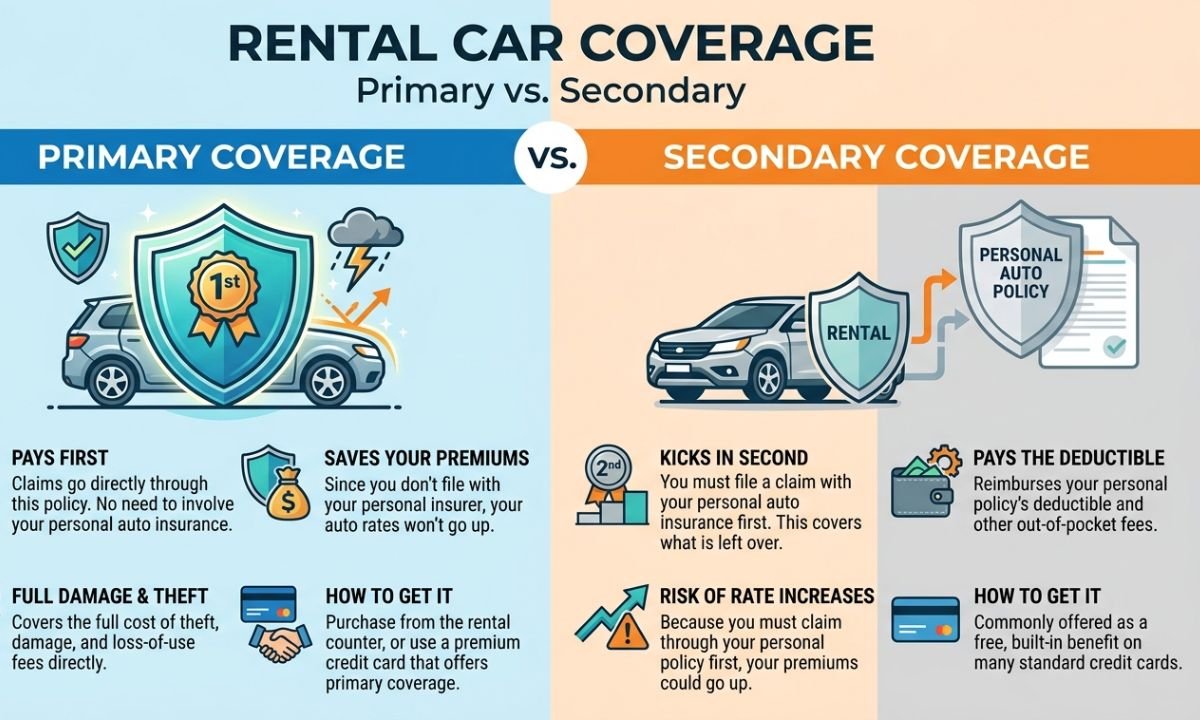
Primary coverage pays first. You do not have to file a claim with your own auto insurer.
Secondary coverage only pays what your personal auto insurance does not. You must claim with your own insurer first. That can mean paying a deductible and facing a higher premium later.
Primary coverage matters most if you own a car and have auto insurance. If you have no personal auto policy, many cards act as your main coverage by default.
Both types share the same basic rules:
- Pay for the entire rental with the card.
- Decline the rental company’s CDW or LDW.
- Make sure the cardholder’s name is on the rental agreement.
If you accept the rental company’s waiver, you usually lose your card’s coverage. If you pay with a different card, you also lose it.
Chase Sapphire Preferred: best overall rental car insurance card
The Chase Sapphire Preferred is the easiest card to recommend. It offers primary coverage, and its benefits guide lists reimbursement for theft or collision up to $60,000, according to The Points Guy.
Reported terms include a 31-day rental limit. Vehicles over $125,000 MSRP and exotic brands are excluded. The card also has a modest $95 annual fee, which makes it a strong value for families who rent a few times a year.
Authorized users get the same coverage when they rent with their own card. One thing to watch: accepting the rental company’s CDW cancels your Sapphire coverage.
Chase Sapphire Reserve: best premium card for frequent renters
The Sapphire Reserve has the strongest terms among the cards covered here. Recent reporting says it provides primary rental coverage up to $75,000 for 31-day rentals worldwide, with no country exclusions.
It also covers loss-of-use fees, towing, and administrative charges. Exotic, antique, and large-capacity vehicles are excluded.
The catch is the price. Reviewers describe it as a $795 card, so it only makes sense if you use its other travel perks too. Families who rent often, or who rent in many countries, get the most from it.
Capital One Venture X: best value premium alternative
The Venture X also gives primary coverage. One guide says it pays actual cash value of the vehicle, with original MSRP up to $75,000.
It has tighter rules than the Chase cards. Reported limits include a 15-day cap on domestic rentals. Coverage is also excluded in the Republic of Ireland, Northern Ireland, Israel, and Jamaica.
This card works well for shorter US trips. For long rentals or Ireland and Jamaica trips, look elsewhere or buy local coverage.
Ink Business Preferred: best for business rentals
The Ink Business Preferred gives primary coverage for business rentals. For personal rentals, the rules change: coverage is secondary only if you rent domestically for personal reasons while holding auto insurance.
Chase has asked for proof of business use in some cases. One review notes that cardholders may need written confirmation from an employer that the rental was primarily for business. Do not use a business card for a family vacation and assume you are covered.
Ink Business Cash and Ink Business Unlimited: best no-annual-fee business options
These two cards carry the same rental car benefit as the Ink Business Preferred. Both have no annual fee, which is rare for a card with primary rental coverage.
For a small business owner who rents a few times a year, that is hard to beat. Keep the same rules in mind: pay in full with the card, decline the waiver, and keep the rental clearly business-related.
Amex cards: good only if you understand the paid coverage
Standard Amex rental coverage is a different story. The standard coverage on eligible American Express cards, including Platinum and Gold, is generally secondary rather than primary.
Amex does offer a paid upgrade called Premium Car Rental Protection. You pay a flat fee per rental, not per day. Past reports put it around $25, so check the current price and your eligibility on the Amex site.
It can be a fair deal for a long rental. Just remember that, like the free coverage, it focuses on damage and theft, not liability.
When to buy insurance from the rental company anyway
Sometimes the rental company’s waiver is the smarter choice. Consider buying it when:
- Your card excludes the country you are visiting
- The vehicle is a large van, truck, luxury car, or other excluded type
- Your rental runs longer than your card’s day limit
- You have no personal auto insurance and no card with primary coverage
- You want zero out-of-pocket risk and no claim paperwork
Paying for the waiver also means you stop worrying about the car. That peace of mind can be worth the cost for some families, especially with kids in the back seat.
Does credit card rental car insurance cover liability?
No. This is the biggest gap. Credit card coverage is for damage to or theft of the rental car. It does not pay if you injure someone or damage their property.
Liability coverage may come from:
- Your personal auto insurance, which often extends to US rentals
- Supplemental liability insurance sold at the rental counter
- A separate non-owner or travel policy
Abroad, the rules vary a lot. Some countries include basic liability in the rental price. Others require you to buy it. Ask the rental company exactly what is included before you sign.
The rental counter script you can use
Counter staff often push their waivers. A calm, clear script helps you stay in control.
- Say, “I will be paying with my [card name] and I am declining the collision damage waiver.”
- If asked about liability, say, “Please tell me what basic liability is already included.”
- Read the agreement before you initial the waiver lines.
- Confirm the card in the contract matches the card you are paying with.
- Photograph or film the car before you drive away, inside and out.
Keep your tone friendly and firm. You are allowed to decline coverage you do not need.
Country and vehicle exclusions travelers miss
Exclusions catch many renters off guard. Check these before you book:
- Country exclusions. Some cards exclude specific countries, as the Venture X does for four. Some countries also require you to buy local insurance, which can override card coverage.
- Vehicle type. Exotic, antique, and expensive cars are commonly excluded. Many large vans, trucks, and motorcycles are too.
- Rental length. Limits often fall between 15 and 31 days.
- Rental type. Ride-share rentals and some peer-to-peer rentals may not qualify.
- Booking issues. Pre-paying with another card, or using a different name than the cardholder, can void coverage.
Larger family vehicles deserve a second look. A 12-passenger van can fall outside coverage even on a strong card.
What about personal auto insurance and travel insurance?
Your personal auto policy may cover US rentals. In the US, personal car insurance only extends to rentals in the USA and, on most policies, Canada. It usually does not help overseas.
If you use your own policy, you may pay a deductible. A claim could also raise your premium. That is why primary card coverage is attractive.
Standard travel insurance often skips rental car damage. Some plans offer it as an add-on. Read the policy details before you assume you are protected.
Which card should you use for different trips?
| Trip type | Best choice | Why |
| US family road trip (under 15 days) | Sapphire Preferred or Venture X | Primary coverage, reasonable terms |
| Long rental (up to 31 days) | Sapphire Preferred or Reserve | Longer coverage windows |
| International trip | Sapphire Reserve or Preferred | Fewer country exclusions reported |
| Business trip | Ink Business card | Primary for business use |
| Ireland or Jamaica | Buy local coverage | Venture X excludes them |
| Large van or luxury car | Rental company waiver | Vehicle likely excluded |
How to file a rental car insurance claim
If something goes wrong, act quickly. Most cards require you to report damage soon after it happens.
- Call the benefit administrator number in your Guide to Benefits right away.
- Gather the original and final rental agreements.
- Get a police report or the rental company’s accident report.
- Keep photos, repair estimates, and receipts.
- Submit your claim before the card’s deadline.
Documents like these are commonly requested: copies of the initial and final auto rental agreement, plus a police report or accident report.
Final recommendation
For most families, the Chase Sapphire Preferred is the best balance of cost, coverage, and flexibility. The Sapphire Reserve is better if you rent often or travel widely. The Venture X suits shorter US trips, and the Ink cards are best kept for business rentals.
Whatever you choose, remember the rules. Pay with the card, decline the waiver, and check exclusions. Then confirm how you will handle liability, since no card covers it. A few minutes of checking before you travel can save you hundreds of dollars at the counter.
Frequently Asked Questions
Is credit card rental car insurance enough on its own?
Not always. It covers damage and theft of the rental car, not liability or injuries. You may still need your own auto policy or supplemental liability coverage.
Do I have to decline the rental company’s insurance?
Yes, in most cases. Accepting their collision waiver usually voids your card’s coverage.
Does coverage work for additional drivers?
It varies by card. Some extend coverage to authorized users who rent with their own card. Check your guide before adding a family member as a driver.
Is Chase Sapphire Preferred rental insurance really primary?
Yes, according to multiple card guides. It pays without requiring you to claim on your own auto insurance first.
Do business cards cover personal vacations?
The Ink cards give primary coverage for business rentals. For personal US rentals, coverage can be secondary if you have auto insurance.
Does credit card insurance cover loss of use and towing?
Many cards do. Chase and Capital One guides list loss-of-use fees, and several list towing and administrative fees. Confirm in your own card’s guide.
What if I rent in another country?
Check your card’s country exclusions first. Some countries also require local insurance by law.






- Be Respectful
- Stay Relevant
- Stay Positive
- True Feedback
- Encourage Discussion
- Avoid Spamming
- No Fake News
- Don't Copy-Paste
- No Personal Attacks
- Be Respectful
- Stay Relevant
- Stay Positive
- True Feedback
- Encourage Discussion
- Avoid Spamming
- No Fake News
- Don't Copy-Paste
- No Personal Attacks
