Best Travel Adapter for International Travel: Top Features to Consider
Published: 27 Oct 2026
You land in a new country, pull out your phone, and the plug does not fit the wall. It happens to almost every traveler at least once. The fix is simple, but the wrong adapter can leave you with a dead phone, a blown fuse, or a damaged laptop charger.
This guide helps you find the best universal travel adapter for your trip. You will learn how adapters work, which plug types you need, and which features are worth paying for. You will also get setups for different types of travelers, including families.
The Short Answer: The Best International Travel Adapter for Most People
For most travelers, the best choice is a compact universal adapter with these traits:
- Plugs that cover the US, UK, Europe, and Australia or Asia
- At least one USB-C port with real charging power
- A replaceable fuse
- A solid fit that does not droop out of the wall
- A clear voltage rating of 100 to 240 volts
If you only visit one region, such as continental Europe, a small country-specific adapter is often lighter and sturdier. If you visit many countries, a universal model saves you from carrying several adapters.
Whichever one you choose, remember this: an adapter changes the plug shape only. It does not change electricity. That brings us to the most important point in this guide.
Adapter vs. Converter: Please Do Not Skip This
A travel adapter lets your plug fit a foreign wall socket. A voltage converter (or transformer) changes the electrical voltage to match your device. They are not the same thing.
Most modern travel gear is dual voltage. Phones, tablets, laptops, cameras, and e-readers usually accept 100 to 240 volts. For these, you only need an adapter.
Problems start with heating tools. Many hair dryers, curling irons, and electric shavers are made for one voltage only. Plugging a 120 volt hair dryer into a 230 volt outlet can ruin it and may cause a fire risk.
Here is a quick way to check:
- Find the small label on your charger or device.
- Look for “INPUT” followed by a voltage range.
- If it says 100-240V, an adapter is enough.
- If it lists a single voltage, such as 120V, you need a converter, or you should leave the device at home.
The simplest solution for hair tools is a dual-voltage travel version, or using the dryer your hotel provides.
Travel Adapter Plug Types by Destination
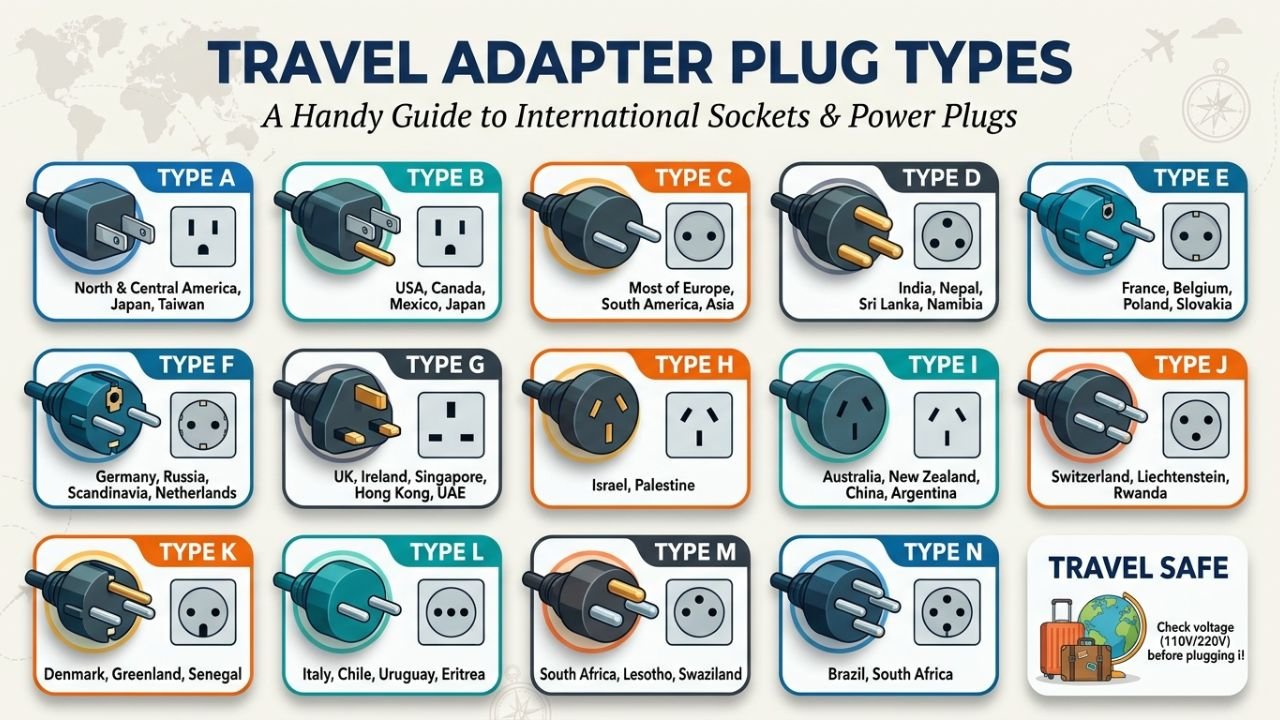
There are around 15 plug types in use worldwide, labeled with letters from A to O. You do not need to memorize them. You only need to know which ones your destination uses.
The table below shows common examples. Standards can vary by building, so always confirm before you go.
| Destination | Common plug types | Typical voltage |
| United States and Canada | A, B | 120 V |
| Most of continental Europe | C, F | 230 V |
| United Kingdom and Ireland | G | 230 V |
| Italy | C, F, L | 230 V |
| Switzerland | C, J | 230 V |
| Denmark | C, E, F, K | 230 V |
| Australia and New Zealand | I | 230 V |
| Japan | A, B | 100 V |
| India | C, D, M | 230 V |
| Thailand | A, B, C, F, O | 220 V |
| Brazil | C, N | 127 V or 220 V (varies by region) |
A few notes that save trouble:
- Many countries mix plug types, so a universal adapter helps.
- Voltage can differ even within one country, as in Brazil.
- Japan uses 100 volts, which is lower than the US. Most dual-voltage electronics handle this fine, but check labels on older devices.
For the most current details, check your destination’s tourism or national electricity information before you travel.
Universal Adapter or Country-Specific Adapter?
This is the core buying choice. Each option has real strengths.
| Feature | Universal adapter | Country-specific adapter |
| Number of countries covered | Many | One region |
| Size and weight | Larger | Very small |
| Fit in the wall | Can be looser | Usually snug |
| USB ports | Often included | Sometimes |
| Best for | Multi-country trips | One destination |
| Price | Usually higher | Usually lower |
A country-specific adapter is hard to beat for simple trips. It is small, cheap, and rarely wobbles.
A universal adapter wins when your plans change often, or when you cross several borders. It also helps if you live in a different country than your passport suggests, or if you are buying one for the whole family to share.
So how do you pick well? Below is how to choose the best universal travel adapter in practice.
Best Travel Adapter for Europe
Europe is where many first-time travelers get confused. Most of the continent uses type C and type F sockets at 230 volts. These accept the common round two-pin plug.
But there are exceptions:
- United Kingdom and Ireland: these use type G, a large three-pin plug.
- Italy: some outlets use type L, which has different pin spacing. Many newer sockets accept type C too.
- Switzerland: type J is common in some buildings.
- Denmark: type K appears in some outlets.
If you plan to visit several countries, a universal adapter that includes UK, Europe, US, and Australia plugs usually covers you. If you stay in Spain, France, and Germany only, a basic type C or type F adapter is enough for most devices.
A grounded device, such as some laptop chargers, may need a type E or F compatible plug to fit properly. Check your charger before choosing.
What Features Are Actually Worth Paying For?
Marketing pages love long feature lists. Most of those features do not matter. These are the ones that do.
USB-C Ports With Enough Wattage
A USB-C port is great, but wattage matters. A low-power port will charge a phone slowly and may not charge a laptop at all.
Here is a practical guide:
- Phones and earbuds: a modest USB-C output is fine.
- Tablets: look for moderate fast-charging power.
- Laptops: check the wattage printed on your laptop charger. Choose an adapter port that can match it, or keep using your original charger through the plug socket.
Also check the total output when several ports are in use. Many adapters share power across ports, so the numbers drop when you charge everything at once.
A Replaceable Fuse
A fuse protects your devices and the wiring in the wall. Good adapters include one you can swap if it blows. Cheap sealed models may simply die.
Check the fuse rating printed on the adapter. It should match or exceed the draw of what you plug in, and it should be listed in the product details.
Grounding, If You Need It
Grounding adds a safety path for stray electricity. Some devices have a three-prong plug, and some have two. Two-prong chargers do not need grounding.
If you carry grounded gear, check that the adapter keeps the ground connection. Many compact universal adapters do not pass it through for every plug type.
Stability in the Wall
Heavy adapters can sag in loose sockets, especially in older hotels. A drooping adapter makes poor contact and can arc or overheat.
Look for a model with a snug fit and sturdy plug blades. A small power cord extension can also help take the weight off the socket.
No Surge-Protector Power Strips
Do not plug a US surge-protector power strip into a foreign outlet through an adapter. These strips are built for 120 volts. At 230 volts, they can overheat or fail.
If you need more outlets, buy a travel power strip rated for worldwide voltage, or one with several USB ports.
My Recommended Setup by Traveler Type
The right kit depends on how you travel. Here are simple setups to start from.
The Weekend City-Break Traveler
Keep it light. One small adapter for your destination and a single wall charger is plenty. A compact USB-C charger can power your phone and earbuds together.
The Two-Week Europe Traveler
A universal adapter with UK and Europe plugs usually works across a multi-country trip. Pack one extra short charging cable, so you are not hunting for outlets near your bed.
The Digital Nomad or Remote Worker
Work gear needs steady power. Choose an adapter with a replaceable fuse, strong build, and enough USB-C wattage. Keep a second adapter as backup, because losing the only one can interrupt work.
The Family Traveler
Families charge a lot at once. Phones, tablets, headphones, and sometimes a portable game console all compete for outlets.
- Choose a multi-port adapter or a compact worldwide-rated power strip.
- Label chargers so kids do not mix them up.
- Carry a spare adapter, since hotel rooms often have few outlets.
- Keep adapters out of reach of small children.
The Photographer or Creator
Camera batteries, laptops, drones, and external drives all draw power. Check each charger label for 100-240V. A multi-port setup with higher total output helps you charge several items overnight.
Travel Adapter Mistakes I Keep Seeing
These errors come up again and again in travel forums and guides.
- Mixing up adapters and converters. Only a converter changes voltage.
- Plugging in 120V hair tools abroad. This is the most common way to ruin a device.
- Buying the cheapest unbranded model. Weak builds and missing safety marks are a risk.
- Ignoring total power limits. Many ports share a single output.
- Forgetting a spare. One lost adapter can leave a whole group without power.
- Packing the adapter in checked luggage only. Keep one in your carry-on for arrival.
How to Use a Travel Adapter
Using one is easy once you know the order of steps.
- Confirm your device accepts the local voltage (look for 100-240V).
- Slide out or select the correct plug on your adapter.
- Insert the adapter firmly into the wall outlet.
- Plug your charger or device into the adapter.
- Switch on the outlet if it has a switch.
- Unplug in reverse order when you finish.
Do not force a plug that does not fit. If it resists, you probably picked the wrong type.
Safety Checks Before Plugging In
Take ten seconds to check these before you start charging.
- Look for cracks, bent pins, or burn marks on the adapter.
- Make sure the outlet is firm and not loose.
- Check that the device label supports local voltage.
- Avoid daisy-chaining several adapters together.
- Do not leave heat-producing gear unattended.
- Feel the adapter after a while. If it is very hot, unplug it.
Also choose adapters with recognized safety marks for your market. A product page that lists no certifications deserves caution.
What About Phones, eSIMs, and Airport Arrivals?
Your phone will almost always be dual voltage, so a plug adapter is enough. The bigger travel question is staying connected on arrival.
Many recent phones support an eSIM, which lets you add a data plan before you land. Setting this up at home means you can get online as soon as you arrive. It also lets you use maps and ride apps right away.
Charge your phone before the flight, and keep a small adapter and cable in your carry-on. Many airports have outlets, but they are often taken. A power bank is a helpful backup. Check your airline’s rules for power banks, since limits apply on flights.
A Simple Buying Checklist
Before you buy, run through this list.
- Does it cover every plug type on my route?
- Does it state a 100 to 240 volt rating?
- Does it have a replaceable fuse?
- Are the USB-C wattage and total output clearly listed?
- Does it pass ground through if I need it?
- Does it feel solid and fit snugly?
- Does it show recognized safety certifications?
- Do my devices all support dual voltage?
If you answer yes to most of these, you have a safe and practical choice.
Conclusion
The best universal travel adapter is not the one with the most plugs or the longest feature list. It is the one that fits your destinations, your devices, and your family’s needs. Remember that an adapter only changes the plug shape, so check voltage labels first.
Look for strong USB-C power, a replaceable fuse, a stable fit, and clear safety information. Skip surge-protector power strips from home. With the right setup, charging abroad becomes one less thing to worry about.
Frequently Asked Questions
Do I need a voltage converter for my phone or laptop?
Usually no. Most phones and laptops accept 100 to 240 volts. Check the label on the charger to be sure.
Is one universal adapter enough for the whole world?
It covers many countries, but not every one. Some places, such as parts of Italy, Switzerland, or Brazil, may use less common sockets. Check your route first.
Can I use my hair dryer abroad with an adapter?
Only if it supports the local voltage. A single-voltage 120V dryer needs a converter, or a dual-voltage travel model is the safer option.
Are universal travel adapters safe?
Good ones are. Look for a replaceable fuse, safety certifications, and a solid build. Avoid damaged or unbranded models.
Do I need a travel adapter for Europe from the US?
Yes. US plugs do not fit European sockets. Most of Europe uses type C and F, and the UK uses type G.
How many adapters should a family bring?
More than one if you charge many devices. A multi-port model plus a spare is a practical starting point.
Can I charge a laptop through a USB-C port on an adapter?
Only if the port provides enough wattage. Check your laptop’s charger rating and compare it with the adapter’s output.





- Be Respectful
- Stay Relevant
- Stay Positive
- True Feedback
- Encourage Discussion
- Avoid Spamming
- No Fake News
- Don't Copy-Paste
- No Personal Attacks
- Be Respectful
- Stay Relevant
- Stay Positive
- True Feedback
- Encourage Discussion
- Avoid Spamming
- No Fake News
- Don't Copy-Paste
- No Personal Attacks
