Travel Hacking with Points and Miles: A 2026 Beginner’s Guide for Families
Published: 4 Nov 2026
Travel hacking with points and miles means using credit card rewards and loyalty programs to pay less for flights and hotels. It works best when you pick one good card, use it on bills you already pay, and redeem with care. For a family, the savings add up fast because you buy four seats and one or two hotel rooms.
The standard starter card, the Chase Sapphire Preferred, has a $95 annual fee. Its public welcome offer is 75,000 points after $5,000 of spending in 3 months. A family of 4 can reach that spend with normal bills, and we estimate the first year at about 84,000 points, worth roughly $840 to $1,680 depending on how you redeem them.
This guide covers how points work, which card to start with, how to earn faster, and how to avoid costly mistakes. 2026 brought big changes at Chase and Hyatt, so the advice here is current as of November 4, 2026. Let’s start with what this means for a family of 4.
Travel Hacking with Points and Miles for a Family of 4
This section assumes 2 adults and 2 children, about 6 to 12 years old. Data was last checked on November 4, 2026. Card terms can change, and this is not personal financial advice.
What One Card Can Do for Four People
| Item | Number | Note |
| Annual fee | $95 | One card covers the whole household |
| Welcome offer | 75,000 points | After $5,000 in 3 months |
| Points from $5,000 of normal spending | about 9,000 | Our estimate |
| Estimated first-year points | about 84,000 | Our estimate |
| Estimated value | $840 to $1,680 | 1.0 cent as cash to 2.0 cents when transferred (estimate) |
| Estimated first-year value after the fee | $745 to $1,585 | Our estimate |
| Kids’ award discount | 25% off miles | Flying Blue only, ages 2 to 11 |
Family Facts That Matter Most
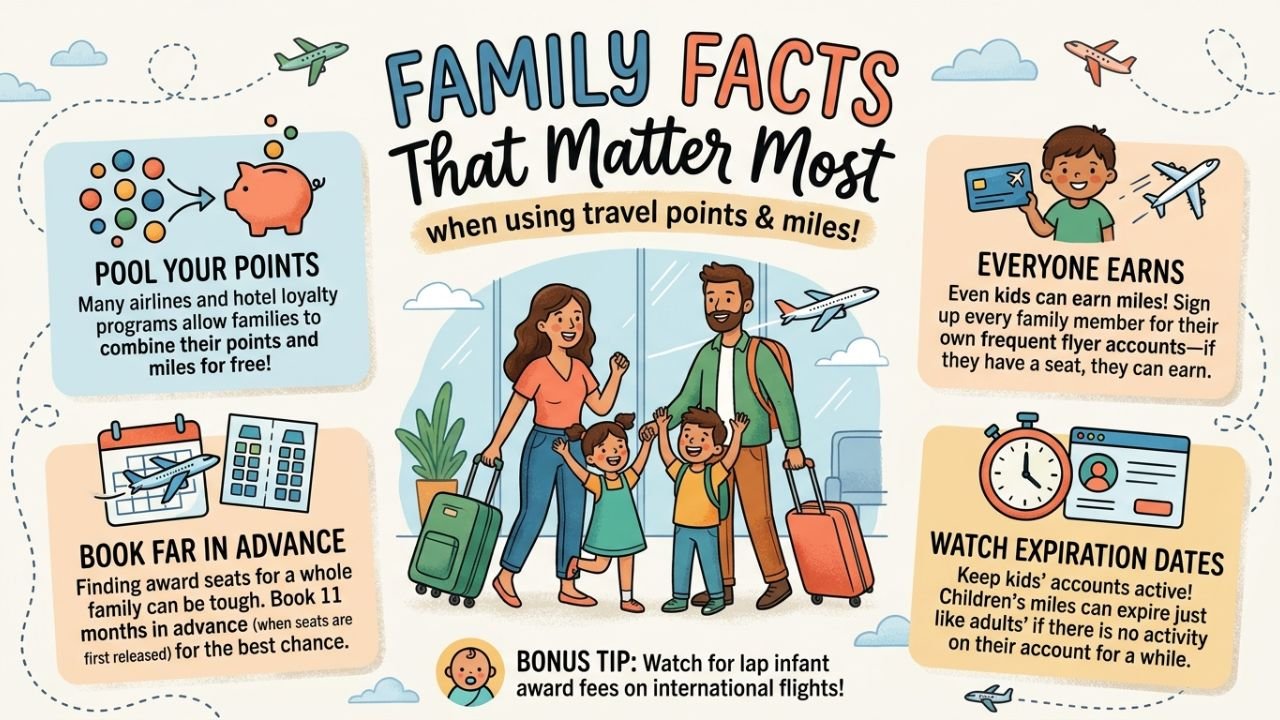
- Each adult can apply for a card, so a couple can earn two welcome bonuses. Families can double up on card bonuses if both are eligible.
- Everyday family spending earns bonus points. The card pays 3x on dining, streaming, online groceries and gas.
- Most airlines give no discount on children’s award tickets. Flying Blue is the notable exception. If an adult ticket costs 40,000 miles each way, a child ticket costs 30,000, so a family of 4 saves 20,000 miles each way (example prices, our estimate).
- You can also book some seats with points and pay cash for the rest. That still saves hundreds of dollars.
- Authorized users on your account may count toward Chase’s 5/24 limit, which we cover below.
Now let’s look at how the points economy actually works.
How the Points Economy Actually Works
You earn points when you spend on a rewards card or stay with a brand. You spend them on flights, hotels, or other travel. The same 50,000 points can be worth $500 or $1,000, depending on how you use them.
Three types of currency matter for a beginner. Each behaves differently.
1. Bank Points (Transferable)
Bank points come from cards like Chase Ultimate Rewards, Amex Membership Rewards, Capital One miles, Citi ThankYou and Bilt. They are the most flexible kind. You can send them to many airline and hotel programs, or use them for cash back or portal bookings.
Flexibility is the point. If one airline has no seats, you try another partner. That choice is why most beginners should start here.
2. Airline Miles
Airline miles belong to one airline or alliance. You earn them by flying or through co-branded cards, and you can also move bank points into them. Their value depends on the airline. For example, Southwest points are worth about 1.5 cents each based on member bookings.
Miles are strongest on long flights and premium cabins. They are weaker on cheap short flights.
3. Hotel Points
Hotel points are tied to one chain. Value swings widely. IHG points average about 0.7 cents each, while Hyatt points tend to be worth much more.
Chains often give you a lot of low-value points. Hyatt gives fewer points that go further. Keep that in mind when you choose a program.
The Math: What Points Are Actually Worth
Use one simple formula. Divide the cash price by the points price, then multiply by 100 to get cents per point. A $450 flight booked for 30,000 points is 1.5 cents each.
A common rule of thumb says that below roughly 1.5 cents per point, you should pay cash and save your points. These values are estimates, not guarantees.
| Currency | Estimated value per point |
| Chase Ultimate Rewards | about 2.0 cents (Upgraded Points, Sept. 2026); 2.05 cents (TPG, July 2026) |
| Capital One miles | about 1.8 cents (Upgraded Points) |
| Citi ThankYou points | about 1.6 cents (Upgraded Points) |
| Chase points as cash back | 1.0 cent |
The gap between 1.0 and 2.0 cents is the whole game. Cash back is easy but leaves half the value on the table.
Step 1: Pick Your First Card Strategically
Start with one card. Choose it for your spending, not for the biggest headline bonus. You should be able to hit the spending requirement with bills you already pay.
Check your credit report first, and make sure you can pay the full balance each month. Then apply. Do not open several cards at once, because that can trigger Chase’s 5/24 limit later.
The Chase Sapphire Preferred ($95/year): Best Starting Point
The Sapphire Preferred has been the standard beginner pick for years. In June 2026, Chase kept the $95 fee while adding new earning categories and benefits.
Here is what the card offers today:
- Earning: 5x on travel booked through Chase Travel, and 3x on dining, select streaming and online groceries. It also earns 3x on gas and EV charging and on vacation rentals.
- Hotel credit: up to $100 a year on hotels booked through Chase Travel.
- Global Entry credit: up to $120 for Global Entry, TSA PreCheck or NEXUS.
- Welcome offer: the public bonus dropped from 100,000 to 75,000 points on July 30, 2026. Targeted offers may still appear.
- Redemption change: the old fixed 1.25 cents per point in the portal was replaced by a variable “Points Boost”.
The biggest downside is the Hyatt transfer rate, which we explain below.
Other Strong First Choices
Compare at least one other card before you apply. Bonuses change often, so check the issuer’s page for the current offer.
| Card | Annual fee | Why consider it |
| Capital One Venture Rewards | $95 | Flat 2x miles on all purchases, simple to use |
| Citi Strata Premier | $95 | 3x at supermarkets, gas stations, restaurants and on travel |
| Amex Gold | $325 | Strong on dining and groceries, but a higher fee |
Families with big grocery and dining bills may like the Citi or Amex options. Families who want simplicity may prefer the Venture.
Step 2: Earn Points Fast (Beyond the Sign-Up Bonus)
The welcome bonus is your biggest single win. After that, steady earning keeps your balance growing. The goal is more points from money you already spend, never extra spending.
Optimize Spending Categories
Match each bill to the card that pays the most for it. On the Sapphire Preferred, put dining, streaming, online groceries and gas on the card. Put trips and hotels through the right booking channel.
Pay everything in full. A rewards rate of 3% means nothing if you pay interest.
Shopping Portals (Overlooked by Beginners)
Many banks and airlines run shopping portals that add bonus points when you click through before buying. Portal rates change often. Compare the portal bonus against any coupon code before you check out.
Only buy what you already planned to buy. A bonus on a purchase you didn’t need is a loss.
Dining Programs
Some airline and hotel programs let you link a card and earn extra miles at participating restaurants. You usually need to register each card first. Check the program’s terms for the current rate and the list of restaurants.
Airline Shopping
Several airlines run their own online malls. These can pay extra miles per dollar on everyday purchases. Treat them like portals: use them when the price is the same, and skip them when it isn’t.
Step 3: The Strategic Redemptions That Actually Matter
Earning is the easy half. Redeeming well is where most beginners lose value. Always compare the points price against the cash price first.
Where Points Shine
- Long-haul flights: transfer bank points to an airline partner for international trips, where cash fares are high.
- Mid-priced hotels on low-demand nights: Hyatt’s lowest tiers can beat cash prices.
- Family-friendly programs: Flying Blue’s 25% child discount for ages 2 to 11 helps a family of 4.
- Points plus cash: some programs let you mix them. Hyatt allows it on standard rooms and suites at most brands.
Where Points Are Wasted
- Gift cards and cash back: you often get about 1 cent per point, half of what a good transfer returns.
- Cheap flights: if a seat costs $120 in cash, spending 15,000 points is poor value.
- Low-value hotel programs: at about 0.7 cents per point, IHG points need very good rooms to be worth it.
- Speculative transfers: experts advise against moving flexible points before you have a specific booking.
The Hyatt Sweet Spot in 2026
Hyatt changed its rules in 2026. As of May 20, 2026, it replaced Off-Peak, Standard and Peak with five tiers: Lowest, Low, Moderate, Upper and Top. Some nights now cost more. For example, a Category 4 room moves from 15,000 points at Standard to 20,000 at Moderate.
Chase made it harder too. Sapphire Preferred transfers to Hyatt dropped from 1:1 to 4:3, so 100,000 Chase points now become 75,000 Hyatt points. The Sapphire Reserve cards keep 1:1, and Bilt also transfers 1:1.
Hyatt can still be a good deal in these cases:
- Lower-category hotels booked at the Lowest or Low tiers.
- Hyatt’s free night certificates, which still work at any tier within their category cap.
- Special trips such as all-inclusive resorts, which NerdWallet lists as a Hyatt sweet spot.
Avoid the top tier unless the cash price is very high. A luxury room at 75,000 points can fall to about 0.9 cents per point.
Step 4: Protect Your Points Strategy
Points only save money if you stay in control of the cards. Three rules keep most beginners safe.
The 5/24 Rule (Chase)
Chase tends to deny applicants who have opened five or more card accounts across all issuers in the last 24 months. The rule is still in effect in 2026, even though Chase has never published it.
Authorized user accounts can count. If one pushes you over, you can call Chase’s reconsideration line and note that you are only an authorized user. Chase business cards usually require you to be under 5/24 but typically do not add to your count.
For families, this matters when you add kids or a spouse to your accounts. Plan Chase applications first, before you open cards at other banks.
Annual Fee Arithmetic
Add up the value you will actually use, then subtract the fee. The Sapphire Preferred’s $95 fee is offset by its $100 hotel credit if you book one hotel stay through Chase Travel. A $325 card needs far more use to break even.
Ask two questions. Will I use the credits without changing my habits? Would I keep this card if the welcome bonus did not exist? If both answers are no, skip it.
Never Carry a Balance
Interest erases rewards quickly. The Sapphire Preferred’s regular APR is 19.24% to 27.49% variable. At 20%, a $2,000 balance costs about $400 a year in interest (our estimate), far more than the points it earns.
Pay the statement balance in full every month. Set up autopay so you never miss a due date.
Practical Timeline: 0 to First Free Flight
A realistic plan takes about 4 to 6 months (our estimate).
- Month 0: Check your credit report and 5/24 count. Pay off any card balances.
- Month 1: Apply for one starter card. Choose the one that fits your family’s spending.
- Months 1 to 3: Move regular bills to the card and reach the $5,000 spending requirement.
- Month 4: Confirm the bonus posted. Search for flights or hotels and compare cash and points prices.
- Months 4 to 6: Transfer points only after you find available seats for the whole family. Book, then keep your receipt.
With about 84,000 points, you may cover a sizable part of a family trip. How far it goes depends on the route and dates.
How to Maximize Travel Points
Small habits add up over the year. Use these tips after you have your first card.
- Search for award seats before you transfer anything.
- Book flexible dates when you can. Family trips tied to school breaks cost more.
- Search seats one traveler at a time, then together, to see which price is lower.
- Pool points with your spouse in programs that allow it.
- Use points plus cash when you are a few thousand short.
- Wait for transfer bonuses when your plans are not urgent.
- Review your cards once a year and drop any that no longer pay for themselves.
Common Beginner Mistakes
- Opening several cards too fast and hitting 5/24 early.
- Spending extra money just to earn the bonus.
- Carrying a balance and paying interest.
- Using points for gift cards or low-value cash back.
- Transferring points before checking availability.
- Ignoring program changes, such as the 2026 Hyatt devaluation.
- Letting points sit unused until a program changes the rules.
The Tools That Make This Easier
- Points trackers: AwardWallet tracks balances and publishes value data based on real bookings.
- Valuation guides: Upgraded Points, The Points Guy and NerdWallet update their estimates regularly. Compare two sources instead of trusting one.
- Airline and hotel award calendars: Hyatt’s own site shows award prices by night.
- Flight search tools: Google Flights helps you check the cash price before you spend points.
- A simple spreadsheet: list your cards, open dates, fees, and due dates to track 5/24 and renewals.
Is Travel Hacking Worth It in 2026?
Yes for most families, if you pay in full and travel at least once a year. A single card with a strong bonus can cut hundreds of dollars from a trip. The effort is small if you keep to one or two cards.
It is less worthwhile if you struggle to pay balances or dislike tracking details. 2026 also showed that programs can cut value without warning. Treat points as a bonus, not a bank account.
Frequently Asked Questions
Is travel hacking worth it for beginners?
Yes, if you pay your balance in full and use one card for everyday bills. A $95 card with a 75,000-point bonus is worth an estimated $750 to $1,500 at 1.0 to 2.0 cents per point.
How much are Chase Ultimate Rewards points worth?
Chase points are worth 1.0 cent as cash back. Analysts value them near 2.0 cents when you transfer them to a good partner.
Does Chase still transfer to Hyatt 1:1?
Not for Sapphire Preferred holders. The ratio is now 4:3, so 100,000 points become 75,000 Hyatt points. Sapphire Reserve cards keep 1:1.
What is the Chase 5/24 rule?
Chase is likely to deny you if you opened five or more personal cards in the past 24 months. Authorized user accounts can count.
Can a family of 4 fly on points?
Yes, but plan ahead. Search for four seats on the same flights, and consider paying cash for one or two tickets if award seats are limited.
Do kids get cheaper award tickets?
Usually not. Flying Blue gives 25% off award tickets for children ages 2 to 11. Most other airlines do not.
Should both parents get the same card?
It can work. Each adult can earn a separate welcome bonus if they qualify. Check each person’s 5/24 status and credit first.
Conclusion
Travel hacking with points and miles is mostly about discipline. Pick one strong starter card, use it for normal bills, pay in full, and compare points prices to cash before you book. The 2026 changes at Chase and Hyatt show why checking current rules matters.
Your family takeaway: have both adults review their eligibility, hit the spending requirement with regular bills, and save the bonus for flights or hotels where you get at least 1.5 cents per point. That alone can cut the cost of your next family trip by hundreds of dollars.






- Be Respectful
- Stay Relevant
- Stay Positive
- True Feedback
- Encourage Discussion
- Avoid Spamming
- No Fake News
- Don't Copy-Paste
- No Personal Attacks
- Be Respectful
- Stay Relevant
- Stay Positive
- True Feedback
- Encourage Discussion
- Avoid Spamming
- No Fake News
- Don't Copy-Paste
- No Personal Attacks
