How to Haggle When Traveling: Essential Tips for Better Deals
Published: 7 Nov 2026
Knowing how to haggle can save you real money on souvenirs, taxis, and tours. It also makes market shopping more fun. In many countries the first price is only an opening offer, and the seller expects you to answer back.
This guide covers when to bargain, what to say, and how to keep it friendly. You will find scripts, region tips, and the mistakes that cost travelers the most. It works whether you travel solo or with kids.
A quick note on prices: All example prices here are in US dollars (USD). Where a local currency matters, the table shows the approximate rate used. These are mid-market rates from early November 2026, based on the ECB reference rates published on 5 November 2026 for most currencies. Rates change daily, so check a currency app before you shop.
| Country | Currency | Approx. amount per $1 |
| Morocco | Dirham (MAD) | about 9.4 |
| India | Rupee (INR) | about 94.5 |
| Thailand | Baht (THB) | about 33.4 |
| Vietnam | Dong (VND) | about 25,600 |
| Mexico | Peso (MXN) | about 18.6 |
| Egypt | Pound (EGP) | about 54 |
| Turkey | Lira (TRY) | about 50 |
| China | Yuan (CNY) | about 6.7 |
Understanding the Cultural Context
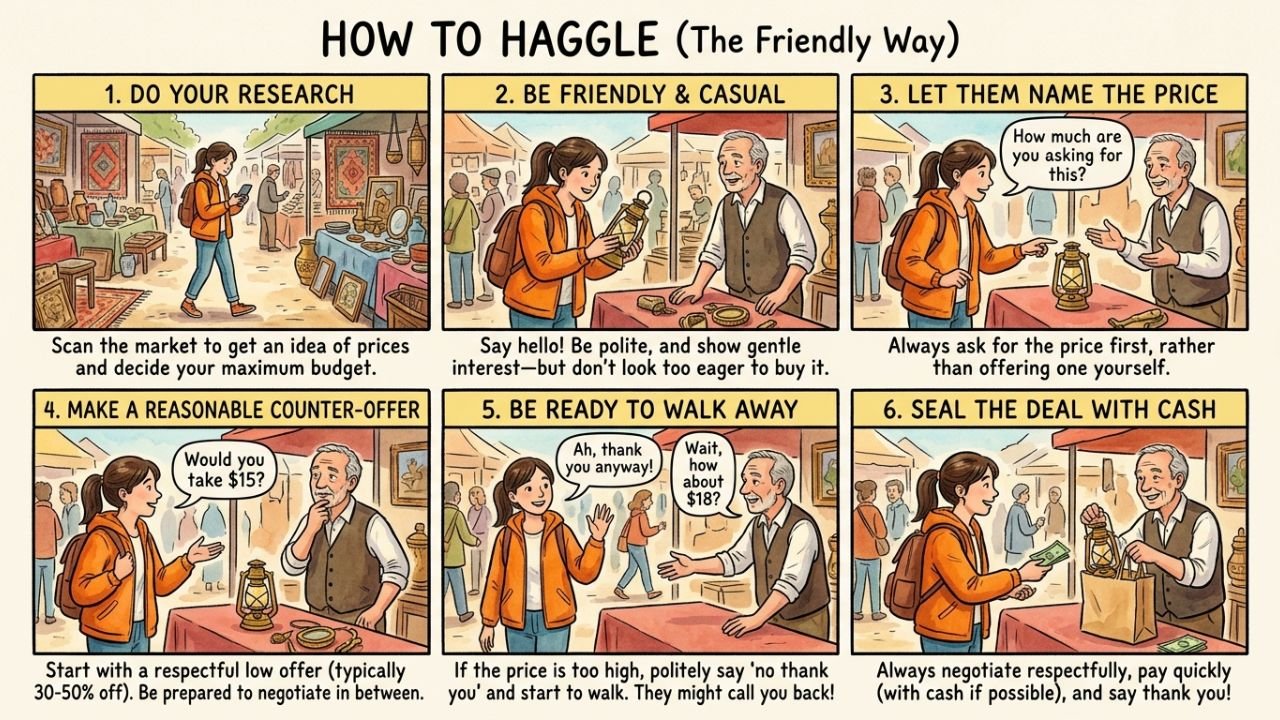
In many parts of the world, a price is the start of a conversation. Shopping is social. You talk, joke, and trade offers. Both sides expect it.
If you come from a fixed-price country like the US or UK, this can feel awkward. It helps to remember that haggling is not an argument. It is a polite game with unwritten rules.
There is also a practical side. Sellers often quote tourists more than locals. Accepting the first price usually means paying extra. A little bargaining brings the price back to something fair.
Where Haggling Is Expected and Welcomed
Bargaining is normal in these places:
- Open-air markets, bazaars, and souks
- Street stalls and night markets
- Small family-run shops with no price tags
- Handmade crafts, rugs, jewelry, and souvenirs
- Taxis and tuk-tuks without meters
- Private guides and day trips booked on the street
- Flea markets and antique stalls
A good rule: if there is no price tag, a price is probably negotiable.
Where Haggling Is Generally Inappropriate
Some places have fixed prices. Trying to bargain there can feel rude or confusing.
- Supermarkets and convenience stores
- Restaurants with printed menus
- Chain stores and department stores
- Pharmacies
- Fruit and vegetable stands with very thin margins
Culture matters too. In Japan and Western Europe, haggling over prices in shops or restaurants is seen as impolite. In Europe, bargaining mostly happens at flea markets, antique fairs, and some souvenir stalls.
The Gray Areas
Some situations sit in the middle. Read the setting before you decide.
- Hotels: Walk-in rates and off-season stays can sometimes be negotiated. Ask politely if there are any better rates.
- Tours and activities: Small operators may give a group discount or a free extra.
- Tourist shops with tags: The price is often firm, but a small discount for buying several items is worth asking about.
- Southern Mediterranean markets: Prices can be flexible in tourist areas, even in Europe.
Watch what locals do. If nobody else is bargaining, don’t start. If a seller has no price on an item, a soft question is fine.
Core Techniques That Work Everywhere
Once you know how to haggle in general, these six habits work in almost any market.
1. Research Before You Shop
Walk through the market first. Check three or four stalls for similar items. Ask hotel staff what a fair taxi fare should be.
You do not need exact numbers. You just need a rough idea of the normal price range.
2. The Anchor Price Technique
The first number sets the tone. When the seller names a price, reply with a lower offer that is still reasonable.
As a rule of thumb, many travelers start well below the asking price in busy tourist markets. The right starting point depends on the place and the item. A very low offer can end the talk before it starts.
3. The Walk-Away Method
Your best tool is being willing to leave. If the price is too high, thank the seller and start walking. Do it calmly and with a smile.
Often the seller will call out a better price. If not, you can shop elsewhere. Never fake this. Only walk away if you truly would not pay that price.
4. Bundle Deals
Buying more than one item gives you leverage. Ask for a price on two scarves instead of one. Sellers like larger sales and will often lower the per-item price.
5. Build Rapport First
Say hello. Ask about the item. Compliment the craftsmanship. A friendly chat makes the seller want to help you. It also keeps the mood light if you disagree on price.
6. Use Cash and Show It
Cash is simple and powerful. Carry small bills in the local currency. Pulling out the exact amount can help close a deal.
It also helps to keep your money in separate pockets. Never pull out a thick wad of notes.
A Sample Negotiation (Example Only)
| Step | Who | Amount |
| Seller’s first price | Seller | $30 |
| Your first offer | You | $10 |
| Seller’s counter | Seller | $24 |
| Your second offer | You | $14 |
| Seller’s counter | Seller | $20 |
| Your final offer | You | $17 |
| Agreed price | Both | $18 |
These numbers are only an example. Real prices depend on the item, the market, and the day.
Scripts and Opening Lines for Different Situations
Short, polite lines work best. Here are some you can adapt.
The Warm Opening (Best for: Turkey, Morocco, India)
In these markets, conversation comes before the price. Take your time.
- “Hello, this is beautiful. Did you make it?”
- “What is your best price for this?”
- “That is a bit above my budget. Could you do better?”
Accepting tea is a kind gesture. It does not mean you have to buy.
The Direct Approach (Best for: China, Thailand, Vietnam)
Sellers here often prefer a quick, clear exchange. Use a calculator or phone to show numbers.
- “How much is this?”
- “I can pay this much.” (Show the number.)
- “If I buy two, what is the price?”
Keep your tone cheerful and brisk.
The Bundle Negotiator (Works everywhere)
- “I would like three of these. What is the best price for all three?”
- “If I take the set, can you include the small one?”
The Polite Walk-Away
- “Thank you, that is too much for me. I will think about it.”
- “I appreciate your time. Maybe next time.”
Say it kindly and leave without drama.
The Return Visit
If you came back after walking away, keep it light.
- “I looked around and came back to you. Can we agree on this price?”
Sellers often respect this. You showed you compared prices and still chose them.
The Ethics of Haggling: Respecting the Seller
Good haggling is fair to both sides. The goal is a price that feels right to you and to the seller.
Know When to Stop
If the seller says the price is final, accept it. Do not keep pushing. Once you agree on a price, complete the purchase. Backing out after a deal is bad manners.
Consider the Context
A few dollars may matter little to you. To a small vendor, it can matter a lot. Think about how much you save compared to what it means to them.
Do not spend ten minutes arguing over a small amount. Save your energy for bigger purchases.
Avoid Performative Poverty
Do not pretend you are broke when you are not. Sellers can tell, and it is unfair. Be honest about your budget instead.
Pay Fair Prices for Handmade Goods
Hand-carved wood, woven rugs, and hand-painted pottery take hours or days to make. Bargain lightly on these. Ask about the process and pay for the skill.
Tip: The “Happy Price” Framework
Before you start, decide your “happy price.” This is the most you would gladly pay for the item. It is not the lowest price you can get.
If the final price is at or below your happy price, you win. If the seller is also happy, even better. That is a good deal.
Region-Specific Strategies
Morocco
Medina markets are lively and rewarding. Take your time and expect a long chat. Be careful with unofficial guides who bring you to certain shops. They often earn a commission, which can raise your price.
Cooperatives and government-run craft shops often have fixed prices. These are useful for checking what an item should cost before you head into the souks.
India
Bargaining is common in bazaars and street stalls. Government-run emporiums often use fixed prices, so you can compare. For auto-rickshaws, use the meter, a prepaid booth, or a ride app when you can. Agree on the fare before you get in if there is no meter.
Smile and stay calm. Raised voices rarely help.
Southeast Asia (Thailand, Vietnam, Cambodia)
Night markets and street stalls are the main places to bargain. Malls and convenience stores have fixed prices. Keep it light and friendly, since the culture values a calm manner.
In Cambodia, US dollars are widely used in tourist areas, which makes price comparison easy. Always check which currency a price is quoted in.
Latin America (Mexico, Peru, Guatemala)
Open-air markets and craft stalls often leave room to bargain. Some travel writers say not haggling can be seen as rude in parts of South America. Still, keep the tone gentle and respectful.
A simple Spanish line goes a long way: “¿Me puede hacer un mejor precio?” (Can you give me a better price?) Rural and less touristy markets often have fair prices, so push less there.
Middle East (Egypt, Jordan, UAE souks)
Souks in Egypt, Jordan, and the UAE are classic places to bargain. In Egypt, agree on taxi fares before you ride. In the UAE, gold is usually priced by weight at a daily rate, so any room to negotiate is often in the labor charge, not the metal.
Large malls and restaurants use posted prices. Save your haggling for the souks.
Haggling With Kids and Family
Haggling with children can be a fun lesson. Give older kids a small budget for one souvenir. Let them practice a friendly offer.
Keep sessions short with little ones. Long negotiations in the heat tire everyone. Do your big purchases when kids are rested, and take breaks for water and snacks.
Also set a family rule: agree on a “happy price” together before you enter a shop.
Common Mistakes to Avoid
- Starting too low. An insulting offer can end the chat.
- Haggling in fixed-price stores. Look for price tags first.
- Showing too much excitement. If you love an item, keep your face calm.
- Not knowing the local price. Without research, you can’t judge a fair deal.
- Bargaining and then not buying. If the seller meets your offer, buy it.
- Arguing over tiny amounts. It costs time and goodwill.
- Carrying only large bills. You may not get change.
- Getting angry. A smile works better than pressure.
Final Thoughts
Learning how to haggle is partly about money and partly about connecting with a place. Do your research, make a fair offer, stay friendly, and know your happy price.
Respect the seller and the local culture. When both sides leave smiling, you have done it right. Use these tips on your next trip, and you will spend less while enjoying the market even more.
Frequently Asked Questions
How much should I offer when haggling?
There is no fixed number. Check prices at a few stalls first, then offer clearly under what you would happily pay. Expect to meet somewhere in the middle. Your happy price is more useful than a set percentage.
Is it rude to haggle?
Not in places where it is the norm, like most souks and street markets. It can be rude in fixed-price stores, restaurants, and supermarkets. Keep it friendly and stop when the seller says the price is final.
How do I haggle if I’m shy?
Start with small, low-stakes items. Practice a simple line like “Is this your best price?” Smiling and speaking softly works well. Using a calculator to show numbers can also help.
Can I haggle for hotels and tours?
Sometimes. Small hotels and local tour operators may give a better rate, especially off-season or for groups. Ask politely and compare a few options. Large chains and online-booked rates are usually fixed.
What should I do if the seller gets upset?
Stay calm and thank them. Walk away politely. Never argue or raise your voice. There are usually many other stalls with similar items.
Should I haggle for taxis and tuk-tuks?
If there is no meter, yes. Agree on the fare before you get in. Ask your hotel what a normal price is, or use a ride app where available.
How do I know if an item is handmade?
Ask the seller how it was made and who made it. Look for small variations that machine-made items do not have. Compare similar pieces across a few stalls before you buy.
What if I don’t speak the local language?
You don’t need to. Numbers on a phone or calculator work in most markets. Learn how to say hello, please, and thank you. A few local words show respect.






- Be Respectful
- Stay Relevant
- Stay Positive
- True Feedback
- Encourage Discussion
- Avoid Spamming
- No Fake News
- Don't Copy-Paste
- No Personal Attacks
- Be Respectful
- Stay Relevant
- Stay Positive
- True Feedback
- Encourage Discussion
- Avoid Spamming
- No Fake News
- Don't Copy-Paste
- No Personal Attacks
