Copenhagen Trip Cost 2026: How Much Does a Trip Cost?
Published: 16 Sep 2026
Planning a trip to Copenhagen and trying to figure out what it will actually cost you? You are not alone. Denmark’s capital has a reputation as one of the priciest cities in Europe, and that reputation is mostly earned. But “expensive” does not mean “impossible to visit on a budget.”
This guide breaks down the Copenhagen trip cost 2026 so you know exactly what to expect for accommodation, food, transport, and activities at budget, mid-range, and luxury levels. You will also find total trip costs for different trip lengths, practical money-saving tips, and a look at the hidden expenses that can catch first-time visitors off guard.
All prices below are per person, per day, in US dollars, unless noted otherwise. Use them as planning estimates. Prices in Copenhagen shift with the season, so always double check current rates before you book.
Copenhagen Daily Cost Summary
Here is the quick version. If you only have time to skim one table, make it this one.
| Travel Style | Accommodation | Food & Drink | Transport | Activities | Daily Total |
| Budget | $21 | $18 | $6 | $9 | $54 |
| Mid-Range | $59 | $51 | $17 | $26 | $153 |
| Luxury | $180 | $113 | $36 | $77 | $406 |
These numbers cover one person. If you are traveling as a couple or a family, accommodation costs usually get split across the group, since most hotel rooms and vacation rentals are priced per room, not per person. Food, transport, and activity costs tend to scale more directly with each additional traveler.
Keep in mind these figures exclude flights to Copenhagen and any travel insurance. They also assume you’re visiting during a typical travel season. Summer (June through August) and the Christmas market period in December tend to push prices, especially for hotels, toward the higher end of each range.
Accommodation Costs in Copenhagen
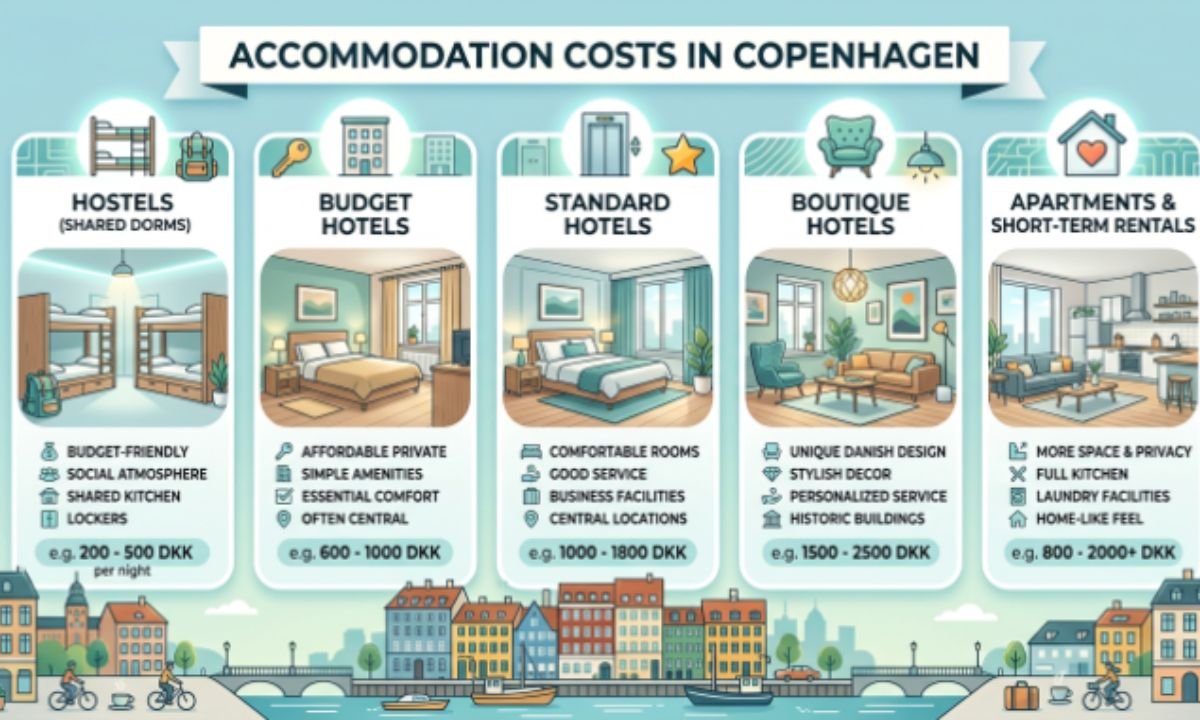
Where you sleep will likely be the single biggest line item in your Copenhagen budget, especially if you are traveling solo. Here is what each tier typically looks like.
Budget ($21/night)
At this price point, you are usually looking at a bed in a hostel dorm room, sometimes a shared room through a budget guesthouse. Popular hostel areas include Vesterbro and Norrebro, both a short walk or bike ride from the city center. Booking early matters here. Copenhagen’s cheapest hostel beds sell out fast in summer.
Mid-Range ($59/night)
This range typically covers a private room in a 2 or 3-star hotel, a budget-friendly Airbnb, or a well-reviewed guesthouse. Many mid-range hotels in Copenhagen are small but well located, particularly around Norreport, Vesterbro, and the area near Central Station.
Luxury ($180/night)
At the luxury level, you are in 4 or 5-star hotel territory, often with a central location in Indre By (the historic city center) or a design-forward property near the harbor. Some of Copenhagen’s best-known luxury hotels sit right along Nyhavn or overlook the water in Christianshavn.
A quick note on family travel: Family rooms and apartment rentals often work out cheaper per person than booking two separate hotel rooms. If you are traveling with kids, look for apartment-style stays with a small kitchen. This also helps cut food costs, which brings us to the next category.
Food & Drink Costs in Copenhagen
Copenhagen’s food scene ranges from cheap street food to some of the most celebrated fine dining in the world (this is, after all, the city that gave us Noma). Your daily food budget depends heavily on how often you sit down at a restaurant versus grab something quick or cook for yourself.
Budget ($18/day)
A budget day of eating in Copenhagen usually means bakery pastries or a grocery store breakfast, a hot dog or shawarma from a street stall for lunch, and a simple self-catered or casual dinner. Danish bakeries (bagerier) are everywhere and are one of the best value food stops in the city. Supermarkets like Netto, Rema 1000, and Lidl are reliable for putting together cheap picnic meals.
Mid-Range ($51/day)
This covers a mix of casual sit-down lunches, a proper restaurant dinner, and a coffee or two along the way. Copenhagen has a huge number of solid mid-range restaurants, particularly in Vesterbro’s Kodbyen (Meatpacking District) and around Torvehallerne food market, where you can sample a wide range of Danish and international food under one roof.
Luxury ($113/day)
At this level, you’re looking at nicer restaurant dinners, a tasting menu experience every so often, and drinks included. Fine dining in Copenhagen, especially at Michelin-recognized restaurants, can push well beyond this daily figure for a single meal, so treat $113/day as a realistic average across a trip rather than a ceiling for any one night out.
Tip: Tap water is safe to drink in Copenhagen and restaurants will usually serve it for free if you ask, though some add a small charge. Bringing a reusable water bottle is one of the easiest ways to trim your daily food and drink spending.
Transport Costs in Copenhagen
The good news: Copenhagen is one of the most walkable and bike-friendly cities in the world, so you can genuinely keep transport costs low here compared to most European capitals.
Budget ($6/day)
At the budget level, you’re mostly walking or renting a city bike, supplementing with the occasional single public transport ticket for longer trips or bad weather days. Copenhagen’s public transport runs on a zone-based ticketing system covering the metro, S-trains, and buses.
Mid-Range ($17/day)
This typically covers a day pass or several single tickets for the metro, S-train, and bus network, which is fast, clean, and runs very late (the metro operates 24 hours on weekends). A day pass is usually the better value if you’re taking more than two or three rides in a day.
Luxury ($36/day)
At this level, you’re mixing public transport with the occasional taxi or rideshare, which in Copenhagen is noticeably pricier than the metro or bus. Airport transfers by taxi, for example, cost significantly more than the metro, which connects directly to Copenhagen Airport (CPH) in about 15 minutes from the city center.
Bike rental note: Renting a bike is one of the most iconic and practical ways to get around Copenhagen. Daily bike rentals are widely available and often pay for themselves within a day or two if you’re planning to cover a lot of ground.
Activities & Entrance Fees
Copenhagen’s attractions range from completely free (many parks, churches, and some museum days) to pricey (Tivoli Gardens ride passes, guided tours, boat trips).
Budget ($9/day)
At the budget level, you’re mostly sticking to free attractions: walking the harbor, visiting Nyhavn, exploring Christiania, and hitting free museum days. Several of Copenhagen’s national museums offer free general admission or free entry on specific days, so it pays to check schedules in advance.
Mid-Range ($26/day)
This covers one paid attraction most days, such as a museum ticket, a canal tour, or gardens access to Tivoli (note that Tivoli’s ride passes cost extra on top of general admission).
Luxury ($77/day)
At this level, you can comfortably fit in multiple paid attractions per day, guided tours, and premium experiences like a private boat charter or a full Tivoli ride pass.
Should you buy a Copenhagen sightseeing card? If you’re planning to hit several paid attractions and rely on public transport, a multi-day Copenhagen Card (sold in versions covering roughly 80+ attractions plus unlimited public transport) can work out cheaper than paying individually. It generally pays for itself if you visit three or more paid sights in a day, or if you’re taking the metro often, including to and from the airport. If your plan leans more toward free attractions and walking, skip it and pay per ticket instead. Prices and included attractions change from year to year, so check the official Copenhagen Card website for current rates before you buy.
Total Trip Cost by Duration
Once you know your daily budget, it’s easy to estimate the full cost of your trip. Here’s how the numbers stack up for common trip lengths, per person, excluding flights.
| Trip Length | Budget | Mid-Range | Luxury |
| 3 days | $162 | $459 | $1,218 |
| 5 days | $270 | $765 | $2,030 |
| 7 days | $378 | $1,071 | $2,842 |
| 10 days | $540 | $1,530 | $4,060 |
For a family of four traveling mid-range for a week, you’re looking at a rough total in the $3,000 to $4,500 range for accommodation, food, transport, and activities combined, though this drops if children stay in the same hotel room as parents or if kids get discounted or free entry to attractions (common for museums and the Copenhagen Card).
Remember, these totals do not include flights. Airfare to Copenhagen varies enormously depending on where you’re flying from and how far ahead you book, so treat it as a separate line item in your overall trip budget.
Money-Saving Tips for Copenhagen
A few smart habits can meaningfully lower your daily spending without making your trip feel like a budget grind.
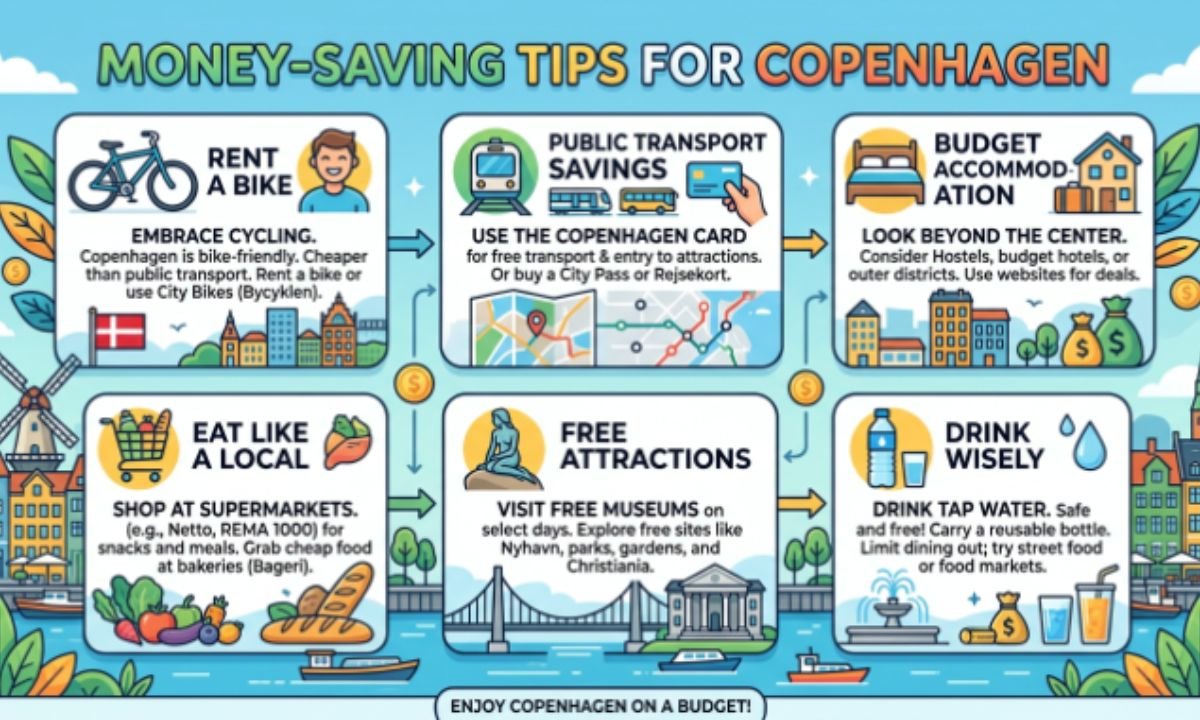
- Cook or picnic at least one meal a day. Grocery stores are far cheaper than restaurants, and Copenhagen’s parks and harborfront make great picnic spots in warmer months.
- Rent a bike instead of relying on taxis. It’s often faster than driving in the city center and dramatically cheaper than a cab.
- Check museum free days before you go. Several major museums offer free entry on specific days of the week.
- Visit in shoulder season. Late spring (May) and early fall (September) tend to offer better hotel rates than peak summer, with milder crowds and still-decent weather.
- Book accommodation early, especially for summer trips. Copenhagen hotels and hostels fill up quickly, and prices rise as availability drops.
- Bring a refillable water bottle. Tap water is safe and free (or nearly free) almost everywhere.
- Compare individual tickets against a Copenhagen Card before committing to either. Run the math on your specific itinerary rather than assuming the card is automatically worth it.
- Look for lunch specials (dagens ret). Many sit-down restaurants offer a discounted “dish of the day” at lunch that can be half the price of the same meal at dinner.
Hidden Costs to Watch For
Even careful planners get caught out by a few Copenhagen-specific costs that don’t always show up in a simple daily budget.
- Bottle deposits (pant). Most bottled and canned drinks include a small deposit in the price, refunded when you return the container to a machine at most supermarkets. It’s a minor cost, but it adds up if you forget to return bottles.
- Restaurant water and bread charges. Some restaurants charge a small fee for tap water or bread service, which is not always obvious on the menu.
- Ride pass add-ons at Tivoli Gardens. General admission to Tivoli does not include unlimited rides. If you want to actually ride the attractions, budget separately for a ride pass or individual tickets.
- Public toilet fees. Some public restrooms charge a small fee, so it’s worth keeping a little cash or a contactless card handy.
- Airport transfer costs. Taxis from Copenhagen Airport into the city are considerably more expensive than the metro, which is fast, direct, and runs frequently.
- Card payment surcharges. Denmark is largely cashless, and most places accept cards, but some smaller vendors or specific card types may add a small surcharge.
- Seasonal price swings. Hotel rates, in particular, can jump significantly around Christmas markets, major festivals, and peak summer weeks.
Is Copenhagen Expensive?
Yes, by most European standards, Copenhagen is expensive. It regularly ranks among the priciest cities in Europe, largely driven by high accommodation and restaurant costs. That said, “expensive” is relative to how you travel.
Compared to cities like Paris, London, or Amsterdam, Copenhagen’s dining out costs and hotel prices tend to run somewhat higher, while its excellent walkability and cycling infrastructure help keep transport costs down. Within the Nordic region, Copenhagen is often considered comparable to or slightly cheaper than Stockholm and Oslo, while remaining pricier than most of continental Europe.
The good news for budget-conscious families is that many of Copenhagen’s best experiences, walking the colorful Nyhavn harbor, exploring free parks, wandering the historic streets of Indre By, watching the changing of the guard at Amalienborg Palace, cost little to nothing. With some planning around accommodation and food, it’s entirely possible to enjoy a memorable Copenhagen trip without spending at the luxury end of the scale.
Conclusion
A trip to Copenhagen can realistically cost anywhere from around $54 a day for a lean budget traveler to $400 or more a day for a fully luxury experience, with accommodation and food making up the bulk of the difference between tiers. The city rewards a bit of upfront planning: booking hotels early, mixing free and paid attractions, and taking advantage of Copenhagen’s walkable, bike-friendly layout to keep transport costs low.
Whatever budget you’re working with, Copenhagen’s mix of historic charm, world-class design, and family-friendly green spaces makes it a destination worth the planning. Use the daily and total cost breakdowns above to build a realistic budget for your own trip, and adjust as needed based on your travel style and the time of year you visit.
Frequently Asked Questions
How much money do I need per day in Copenhagen?
Budget travelers should plan for roughly $54 a day, mid-range travelers around $153 a day, and luxury travelers around $406 a day, per person, covering accommodation, food, transport, and activities. Flights are not included in these figures.
Is Copenhagen more expensive than other European capitals?
Copenhagen tends to be pricier than cities like Berlin, Prague, or Lisbon, largely because of higher accommodation and restaurant costs. It’s often comparable to or slightly cheaper than Stockholm and generally more affordable than the very top-tier expensive cities in the region.
What is the cheapest time of year to visit Copenhagen?
Late fall and winter, outside the Christmas market period, tend to have the lowest hotel prices. Shoulder seasons like May and September offer a good balance of decent weather and lower costs than peak summer.
Is the Copenhagen Card worth buying?
It depends on your itinerary. If you plan to visit three or more paid attractions in a day, or you’ll be using public transport frequently, the card can save money. If you prefer walking and mostly free attractions, buying individual tickets is usually cheaper.
How much should I budget for food each day in Copenhagen?
Expect around $18 a day on a tight budget using bakeries, street food, and groceries, $51 a day for a mix of casual and sit-down restaurant meals, or $113 a day if you want to include nicer dinners regularly.
Is Copenhagen a good destination for families on a budget?
Yes. Many of Copenhagen’s best attractions, like Nyhavn, city parks, and the harborfront, are free. Booking apartment-style accommodation with a kitchen and taking advantage of free museum days can significantly cut costs for families.
Do I need cash in Copenhagen, or is it mostly cashless?
Denmark is largely a cashless society. Cards are accepted almost everywhere, including small vendors, so you can generally get by with minimal cash on hand. It’s still worth carrying a small amount for the rare exception, like certain public restrooms.
How much does a week in Copenhagen cost for one person?
Based on the daily averages above, a 7-day trip runs roughly $378 on a budget, $1,071 mid-range, or $2,842 for a luxury trip, per person, not including flights.





- Be Respectful
- Stay Relevant
- Stay Positive
- True Feedback
- Encourage Discussion
- Avoid Spamming
- No Fake News
- Don't Copy-Paste
- No Personal Attacks
- Be Respectful
- Stay Relevant
- Stay Positive
- True Feedback
- Encourage Discussion
- Avoid Spamming
- No Fake News
- Don't Copy-Paste
- No Personal Attacks
